Showing posts with label prince edward sziget. Show all posts

Saturday, 20 August 2011

Prince Edward Island (PEI)

Prince Edward Island (PEI or P.E.I.;


Prince Edward Island Canada


Prince Edward Island Canada

French: Île-du-Prince-Édouard, pronounced: [il dy pʁɛ̃s edwaːʁ], Scottish Gaelic: Eilean a' Phrionnsa) is a Canadian province consisting of an island of the same name, as well as other islands. The maritime province is the smallest in the nation in both land area and population (excluding the territories). The island has a few other names: "Garden of the Gulf" referring to the pastoral scenery and lush agricultural lands throughout the province; and "Birthplace of Confederation", referring to the Charlottetown Conference in 1864, although PEI did not join the confederation itself until 1873 when it became the seventh Canadian province.


Prince Edward Island Canada


Prince Edward Island Canada


According to the 2009 estimates, Prince Edward Island has 141,000 residents. It is located in a rectangle defined roughly by 46°–47°N, and 62°–64°30′W and at 5,683.91 km2 (2,194.57 sq mi) in size, it is the 104th largest island in the world, and Canada's 23rd largest island.


Prince Edward Island Canada


Prince Edward Island Canada

The island was named for Prince Edward, Duke of Kent and Strathearn (1767–1820), the fourth son of King George III and the father of Queen Victoria.


Prince Edward Island Canada


Prince Edward Island Canada


Prince Edward Island Canada


Prince Edward Island (PEI Canada)


Prince Edward Island
Île-du-Prince-Édouard (French)


Motto: Latin: Parva sub ingenti
(The small protected by the great)
Capital Charlottetown
Largest city Charlottetown
Largest metro Charlottetown
Official languages English (de facto)
Demonym Prince Edward Islander, Islander
Government
Type Constitutional monarchy
Monarch Elizabeth II
Lieutenant Governor Frank Lewis
Premier Robert Ghiz (Liberal)
Legislature Legislative Assembly of Prince Edward Island
Federal representation in Canadian parliament
House seats 4
Senate seats 4
Confederation July 1, 1873 (7th)
Area  Ranked 13th
Total 5,683.91 km2 (2,194.57 sq mi)
Land 5,683.56 km2 (2,194.43 sq mi)
Water (%) 0 km2 (0 sq mi) (0%)
Population  Ranked 10th
Total (2009) 141,551 (est.)
Density 23.9 /km2 (62 /sq mi)
GDP  Ranked 10th
Total (2009) C$4.75 billion
Per capita C$31,278 (13th)
Abbreviations
Postal PE
ISO 3166-2 CA-PE
Time zone UTC-4
Postal code prefix C
Flower Pink Lady's Slipper
Tree Red Oak
Bird Blue Jay
Website www.gov.pe.ca


Prince Edward Island


Prince Edward Island


Prince Edward Island


Prince Edward Island


Prince Edward Island


Prince Edward Island

Prince Edward Island Canada

Prince Edward Island Canada
Prince Edward Island is located in the Gulf of St. Lawrence west of Cape Breton Island, north of the Nova Scotia peninsula, and east of New Brunswick. Its southern shore bounds the Northumberland Strait. The island has two urban areas. The largest surrounds Charlottetown Harbour, situated centrally on the island's southern shore, and consists of the capital city Charlottetown, and suburban towns Cornwall and Stratford and a developing urban fringe. A much smaller urban area surrounds Summerside Harbour, situated on the southern shore 40 km (25 mi) west of Charlottetown Harbour, and consists primarily of the city of Summerside. As with all natural harbours on the island, Charlottetown and Summerside harbours are created by rias.
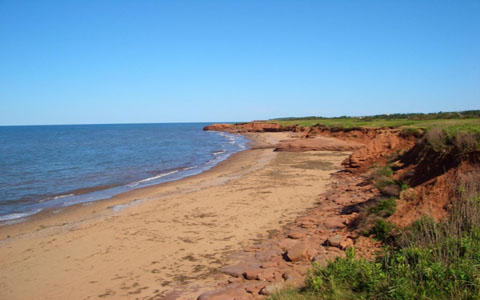
The island's landscape is pastoral. Rolling hills, woods, reddish white sand beaches, ocean coves and the famous red soil have given Prince Edward Island a reputation as a province of outstanding natural beauty. The provincial government has enacted laws that attempt to preserve the landscape through regulation, although the lack of consistent enforcement and absence of province-wide zoning and land-use planning recently resulted in aesthetically displeasing development.
The landward side of sand dunes in Cavendish
The island's lush landscape has a strong bearing on its economy and culture. Author Lucy Maud Montgomery drew inspiration from the land during the late Victorian Era for the setting of her classic novel Anne of Green Gables. Today, many of the same qualities that Montgomery and others found in the island are enjoyed by tourists who visit year-round. They enjoy a variety of leisure activities, including beaches, various golf courses, eco-tourism adventures, touring the countryside, and enjoying cultural events in local communities around the island.
The smaller, rural communities as well as the towns and villages throughout the province proudly retain a slower-paced, old-world flavour, something factoring heavily into Prince Edward Island's popularity as a destination for relaxation. The economy of most rural communities on the island is based on small-scale agriculture, given the size of farm properties is small when compared with other areas in Canada. There is an increasing amount of industrial farming as older farm properties are consolidated and modernised.
The coastline consists of a combination of long beaches, dunes, red sandstone cliffs, salt water marshes and numerous bays and harbours. The beaches, dunes and sandstone cliffs consist of sedimentary rock and other material with a high iron concentration which oxidises upon exposure to the air. The geological properties of a white silica sand found at Basin Head are unique in the province; the sand grains cause a scrubbing noise as they rub against each other when walked on, aptly named the singing sands. Large dune fields on the north shore can be found on barrier islands at the entrances to various bays and harbours. The magnificent sand dunes at Greenwich are of particular significance. The shifting, parabolic dune system is home to a variety of birds and rare plants and is also a site of significant archeological interest.


Prince Edward Island Canada


Prince Edward Island Canada


Add caption


Prince Edward Island Canada


Prince Edward Island Canada

Prince Edward Island Canada

Prince Edward Island

Canada's smallest province, Prince Edward Island is only about as big as the state of Delaware, or twice the size of Luxembourg. Its shape could be likened to a tattered butterfly, its wings outstretched and poised for flight at the sheltered southern edge of the Gulf of St. Lawrence.


Prince Edward Island Canada


Prince Edward Island Canada


Prince Edward Island Canada


Prince Edward Island Canada

 
Prince Edward Island, or PEI, is beautifully manicured and predominantly rural. The fields of nodding wheat and neatly combed rows of potato plants that yield the island's agricultural mainstays spread across thousands of acres, interrupted by spanking-white farmhouses and tracts of woodland.
The last ice age is responsible for the ragged shape of the island, which in places seems only tenuously sutured together by slender isthmuses. The retreating ice sheets shoved several chunks of land together to form one landmass. The component parts are still clearly discernible: the island's central part is flanked, for example, with wing-shaped additions on both sides. The configuration is most noticeable at Summerside, which sits on a mere slip of a six-km-wide isthmus connecting the western and central sections. Nowadays, counties mark the province's three parts: Kings County on the east, Queens County in the center, and Prince County on the island's western side.


Prince Edward Island Canada


Prince Edward Island Canada

Over the years, PEI has acquired numerous nicknames. The province is known as the "Birthplace of Canada," a distinction earned in 1864 when representatives of England's colonies in eastern Canada convened for informal meetings in Charlottetown. Those meetings resulted in the creation of the Confederation of Canada three years later. The nationally esteemed painting that marked the event, "Fathers of Confederation," was painted by island artist Robert Harris.
In literary circles, Prince Edward Island is known as the pastoral "Avonlea" of island author Lucy Maud Montgomery’s Anne of Green Gables. This juvenile novel and its sequels, set in the Cavendish area on PEI's gulf seacoast, draws many thousands of visitors from around the world to the area each year—visitors who read the books as children and fell in love with the stories and their setting.
As for the rest of the Atlantic Canadians, they've dubbed PEI "Spud Island," a tribute of sorts to Canada's major producer of table and seed potatoes. Islanders themselves see their fertile province—about half of which is given over to farmland—as the "Garden of the Gulf" or the "Million-Acre Farm."
All of which hardly hints at what it is that attracts nearly three-quarters of a million visitors a year to PEI. The province is a tranquil and harmonious reminder of what the world was like decades ago. Its long, untrafficked roads for biking, quiet woods and trails for hiking, scores of excellent beaches, and several splendid golf courses invite you to enjoy the outdoors. Island cuisine takes full advantage of local produce and the rich surrounding seas. Add summertime dinner theaters and plays, friendly people, shops with quality crafts, and a gentle, lovely landscape, and you'll understand what brings visitors back again and again.


Prince Edward Island Canada


Prince Edward Island Canada

Prince Edward Island In Canada

Prince Edward Island

Canada's smallest province, Prince Edward Island is only about as big as the state of Delaware, or twice the size of Luxembourg. Its shape could be likened to a tattered butterfly, its wings outstretched and poised for flight at the sheltered southern edge of the Gulf of St. Lawrence.

Prince Edward Island, or PEI, is beautifully manicured and predominantly rural. The fields of nodding wheat and neatly combed rows of potato plants that yield the island's agricultural mainstays spread across thousands of acres, interrupted by spanking-white farmhouses and tracts of woodland.
The last ice age is responsible for the ragged shape of the island, which in places seems only tenuously sutured together by slender isthmuses. The retreating ice sheets shoved several chunks of land together to form one landmass. The component parts are still clearly discernible: the island's central part is flanked, for example, with wing-shaped additions on both sides. The configuration is most noticeable at Summerside, which sits on a mere slip of a six-km-wide isthmus connecting the western and central sections. Nowadays, counties mark the province's three parts: Kings County on the east, Queens County in the center, and Prince County on the island's western side.


Prince Edward Island Canada


Prince Edward Island Canada


Prince Edward Island Canada

Over the years, PEI has acquired numerous nicknames. The province is known as the "Birthplace of Canada," a distinction earned in 1864 when representatives of England's colonies in eastern Canada convened for informal meetings in Charlottetown. Those meetings resulted in the creation of the Confederation of Canada three years later. The nationally esteemed painting that marked the event, "Fathers of Confederation," was painted by island artist Robert Harris.


Prince Edward Island Canada


Prince Edward Island Canada

In literary circles, Prince Edward Island is known as the pastoral "Avonlea" of island author Lucy Maud Montgomery’s Anne of Green Gables. This juvenile novel and its sequels, set in the Cavendish area on PEI's gulf seacoast, draws many thousands of visitors from around the world to the area each year—visitors who read the books as children and fell in love with the stories and their setting.


Prince Edward Island Canada


Prince Edward Island Canada

As for the rest of the Atlantic Canadians, they've dubbed PEI "Spud Island," a tribute of sorts to Canada's major producer of table and seed potatoes. Islanders themselves see their fertile province—about half of which is given over to farmland—as the "Garden of the Gulf" or the "Million-Acre Farm."
All of which hardly hints at what it is that attracts nearly three-quarters of a million visitors a year to PEI. The province is a tranquil and harmonious reminder of what the world was like decades ago. Its long, untrafficked roads for biking, quiet woods and trails for hiking, scores of excellent beaches, and several splendid golf courses invite you to enjoy the outdoors. Island cuisine takes full advantage of local produce and the rich surrounding seas. Add summertime dinner theaters and plays, friendly people, shops with quality crafts, and a gentle, lovely landscape, and you'll understand what brings visitors back again and again.